

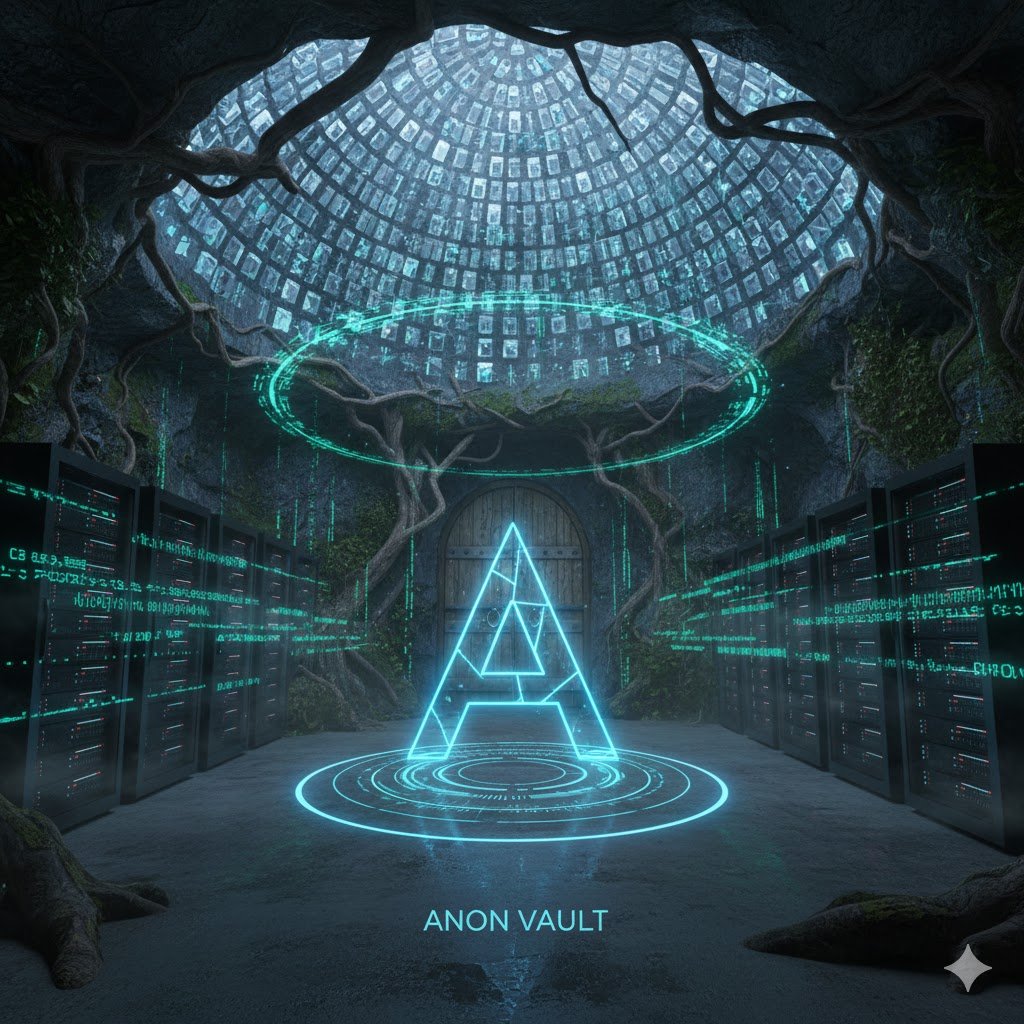
In the digital age, information has not only become indispensable but it is also dangerously vulnerable. Due to people, organizations, and even countries relocating vital systems to the Internet. The question that is rapidly rising is not only, Is my data safe? but “Can anyone see it at all?”
Storing and sharing of files has never been more convenient than it is with the conventional cloud storage providers such as Google Drive, Dropbox, and iCloud. However, most of these platforms are accumulating personal data, storing metadata. The possibly subjecting user material to breaches, tracking, or unauthorized access.
Anon Vault is a new generation file submission and sharing service built entirely on new foundations to ensure privacy and anonymity that only traditional services can only fall short of. Anon Vault in essence comprises a privacy-first, anonymous, and encrypted digital storage platform. It allows individuals to store, manage and share files without relinquishment of personal data or relinquishment of encryption key control.
It accompanied by decentralized technologies and security practices under the control of the user. This article will discuss its architecture, functionality, technologies, advantages and constraints it offers, and why its philosophy represents a new stream of thinking in digital privacy.
What Is Anon Vault? A Primer on the Concept:
Even the name of the site, Anon Vault, is a hybrid of two great notions: Anon (anonymous): It symbolizes the protection of identity, discretion, and the lack of any traces online. “Vault”: This word gives an image of fortified, strong, and safe storage facility, where sensitive information cannot be intruded.
These ideas combined are what create a platform that is your online refuge to your most confidential files. Contrary to the conventional cloud storage, which usually promotes the use of emails, phone numbers, user accounts, etc., starting traceable footprint,
Anon Vault generally does not need any personally identifiable information at all. This implies that there is no login, no account, no identifiers and most importantly no metadata that can be used to tie stored material to real-world identity.
Rather, the users are assigned with cryptographic access keys, which are basically long strings of character, functions as the only mechanism to their storage. The stored data can not be accessed or decrypted by a platform or anyone without such keys.
The functionality of Anon Vault: An overview of major technologies:
Anon Vault runs on a combination of sophisticated technologies that support the user interface to form a secure, anonymous and resilient storage ecosystem in the background. We can divide the aspects that are the most important: End-to-End Encryption (E2EE) Anon Vault encrypts information on the computer of the user even before it leaves the system.
It implies that the file remains in encrypted (scrambled) form even in the process of transmission and storage. The decryption keys never sent or stored on the platform, but rather on the part of the user. This encryption usually done using AES-256 or more powerful cryptographic algorithms. Which generally accepted as having high standards in the industry.
Practically, this makes sure that although one had taken possession of the stored files by a hacker or a government agency, he/she could not read a bit without the appropriate key.
Zero-Knowledge Architecture:
Zero-knowledge system refers to the fact that the service provider does not have access or the ability to recreate your information even when they desire. The zero-knowledge architecture at Anon Vault grants that: No server contains any passwords.
The provider never possesses encryption keys. The usage patterns and user data is not visible to the platform. This type of design significantly minimizes the chances of being surveilled, data breaches, and privacy invasion since the keyholder is the only person who can gain access. Data is encrypted without the key such that it cannot be understood.
Decentralized Storage:
Instead of having one physical server or centralizing data center, Anon Vault frequently uses the decentralized storage. These mechanisms like: IPFS (Interplanetary file system) – a distributed file system on a peer-to-peer model. Networked storage nodes – file fragments are stored in more than one location all over the world.
To store storage transaction or access event, blockchain or distributed ledger technologies (in certain implementations) are used. The methodology spreads information in a manner that does not create centralized points of breaches and less prone to takedowns, censorship or centralized failures.
Self-Destructing Files and Time-Bound Files:
Anon Vault enables one to make rules that have expiration on stored files. These can include: Auto-delete when there is a specific number of downloads. The keys expire automatically after a defined time (e.g. one hour, a day, one week). Manual deletion by use of a special deletion link.
No Accounts Anonymous Access:
Anon Vault is one of the most recognizable sites where you do not require an account to use it. No usernames, passwords, phone numbers or email addresses are required. Rather than that, the access key is your identity on the platform.
Optional Tor and VPN Support:
Anon Vault frequently accepts access via The Onion Router (Tor) network or virtual private networks. It ensures those users who require the additional degree of anonymity. Tor directs the traffic via various relays that hides the IP address and position of the user. This complicates digital activities to an even greater degree to be traced to a person.
Why Anon Vault is Important:
The Privacy-First Storage Case. The issue of digital privacy is no longer luxurious, but it is becoming a necessity. Large-scale surveillance programs, security breaches, and unethical data collection by companies have rendered the reliance on third-party services more dangerous.
Conventional cloud storage providers constantly gather metadata. It demand user information, and are authorized to access files they store under some conditions.
Who is meant to use Anon Vault?
Although personal grocery lists or personal documents can be especially useful to an ordinary user stored in a secure place, some groups find anonymous storage particularly useful:
1. Whistleblowers and Journalists.
In the case of sensitive reports, source documents, or leaked material, Anon Vault will be a safe deposit box. Where no individual or the operator of the platform will ever be allowed to read or track stored files.
2. Activists in the High-Risk Regions.
In censored areas or areas where they are being followed, political activists can distribute documents and collaborate without putting themselves at risk of being tracked or leaving any metadata tracks.
3. Financial Professionals and Legal.
Financial advisors, compliance officers, and attorneys regularly share confidential files. Anon Vault will enable the transmission and storage of sensitive data without exposing the clients to third parties.
4. Ordinary Conscious Privacy Citizens.
Anon Vault privacy can be used by whoever worried about their personal information being visible online i.e. family photos, tax records, or personal correspondence.
5. Businesses In Search of Conformity.
In the case of companies that have to comply with harsh data protection laws such as GDPR, the zero-knowledge architecture of Anon Vault may be useful to address data minimization and privacy by design.
Anon Vault has some very strong benefits:
Although Anon Vault has some very strong benefits, there are some trade-offs and considerations that the user must remember:
1. Lost Keys.
Lost Data Since Anon Vault does not save user credentials or backups, once you have lost your access key, normally there is no way to recover your files. Password reset not often offered.
2. Learning Curve.
As much the user interfaces improving, the cryptographic keys, self-destructing storage concepts will not be embraced by non-technological user at the outset.
3. Speed and Scalability.
Large files sometimes faster stored on the centralized systems than the decentralized systems depending on the network latency and the availability of the nodes.
4. Credibility and Authentication.
Like any privacy technology, it is also important to ensure the platform is compliant with its published privacy policies (e.g., by viewing open-source code and using third-party analysis). Implementations by users should be those that have clear security practices.
Discussion
A New Frontier in Secure Digital Storage. Anon Vault is at the border of security, privacy and personal freedom. It provides a data-centric business model. Anon alternative to the traditional cloud storage services by eliminating personal identifiers. Basically it is end-to-end encryption, and using decentralized technologies.
